

- How To Watch The Saints Game: New Orleans Vs. Minnesota Vikings: Stream, TV, Radio Options - October 10, 2026
- Best Étouffée In New Orleans: 7 Restaurants That Don’t Miss - October 10, 2026
- New Orleans Saints 2026 Schedule: Dates, Times, Opponents, Scores - October 10, 2026
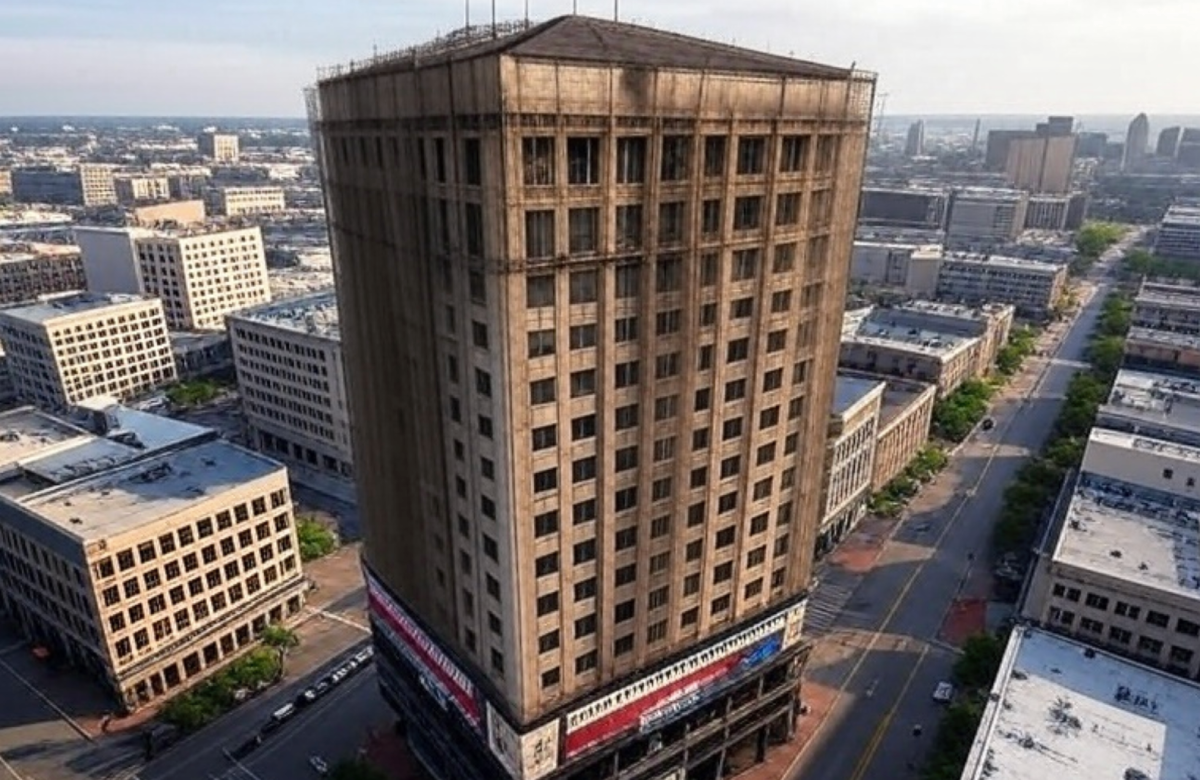
For decades, the Plaza Tower, a 45-story skyscraper looming over New Orleans’ Central Business District at 1001 Howard Avenue, has stood as a stark symbol of urban decay.
Once the tallest building in the city and state, this modernist structure, designed by Leonard R. Spangenberg, Jr. & Associates and completed in 1969, has been vacant since 2002, plagued by environmental hazards, safety concerns, and repeated failed redevelopment efforts.
As the city prepares to host Super Bowl LIX in February 2025, the future of this iconic eyesore hangs in the balance, with plans for either demolition or a transformative redevelopment into affordable senior housing gaining traction.
A Troubled History
The Plaza Tower’s story began in 1964 as an ambitious project by developer Sam J. Recile, but construction stalled in 1966 due to financial difficulties. Resumed in 1968 and completed a year later, the 531-foot tower briefly held the title of New Orleans’ tallest building until it was surpassed by the Hancock Whitney Center in 1973. Initially envisioned as a mixed-use development, the tower saw limited residential use, with most of its space converted to offices by 1984.
By 2001, tenants, including employees of the Louisiana Department of Social Services and the New Orleans District Attorney’s Office, began reporting hazardous conditions, including exposure to asbestos and toxic mold due to poor maintenance.
Class-action lawsuits followed, and in 2002, approximately 700 state and city employees relocated, leaving the building abandoned. Environmental remediation efforts in the late 2000s addressed the asbestos and mold issues, but the tower remained unused, its condition deteriorating further.
Safety Concerns and Public Hazard
The Plaza Tower’s decline has not been without incident. In May 2021, high winds dislodged debris from the building, injuring a cyclist and prompting the closure of major roads like Howard and Loyola Avenues.
This incident led to the installation of protective netting and fencing, though these measures have proven insufficient, with further debris falls reported as recently as November 2024, damaging a car but causing no injuries. A fire in January 2022, followed by another in April 2023, believed to be set by squatters, underscored the building’s vulnerability to trespassers.
Most tragically, on April 24, 2023, a man fell to his death from the tower, hours after another fire was extinguished, highlighting ongoing security challenges.
The building’s dilapidated state has drawn sharp criticism from residents and officials. “It’s a black eye for the developing downtown scene,” said local activist Casandra Sharpe in 2021, echoing sentiments of frustration over the tower’s neglect. City Councilmember Lesli Harris, whose district includes the Plaza Tower, has been vocal about the need for action, stating, “We have to secure this building. We have to get it back into commerce or demolish it.”
Demolition or Redevelopment?
The Plaza Tower’s fate has been a subject of debate for years. In December 2024, the New Orleans City Council approved a $2.7 million plan to stabilize the building, a precursor to a potential $28 million demolition, citing its extensive code violations and safety risks.
The decision came after years of legal battles and fines totaling nearly $400,000 imposed on the late owner, Joe Jaeger, who purchased the property in 2014.
Jaeger’s death in a car accident in June 2024 complicated matters, with his estate, managed by executor Randy Waesche, initially resisting demolition plans. A temporary restraining order briefly halted the city’s efforts in early 2025, but an Orleans Parish judge ruled in January 2025 to allow contractors to proceed with safety assessments and preparations for potential demolition.
However, a glimmer of hope for redevelopment emerged in June 2025 when the tower was sold to developers Brian Gibbs and Lincoln Avenue Capital.
The new owners, in collaboration with Waesche, proposed a $250 million plan to transform the Plaza Tower into a 300-unit assisted living facility for seniors, leveraging federal, state, and local subsidies.
The project, still in early stages, aims to capitalize on the building’s prime location and stunning views, particularly from its upper floors. “This would be a facility for the elderly,” Waesche said, emphasizing the city’s support for the initiative.
Super Bowl SpotlightWith Super Bowl LIX approaching, the Plaza Tower’s proximity to the Caesars Superdome has intensified efforts to address its condition. In June 2024, Super Bowl organizers proposed wrapping the building’s lower ten floors with decorative signage to mask its blight, as full demolition or renovation before the event was deemed unfeasible. The city has also prioritized stabilizing the structure to prevent further incidents, with contractors from Renascent Inc. tasked with conducting a floor-by-floor assessment using drones and 3D imaging.
A City DividedThe Plaza Tower’s future remains uncertain, with demolition and redevelopment plans both facing significant hurdles. Demolition carries a hefty price tag and logistical challenges, while the assisted living project hinges on securing complex financing.
Mayor LaToya Cantrell, who included the tower on her “Dirty Dozen” list of blighted properties, has expressed openness to either outcome but stressed the need for resolution. “We don’t know how much it’s going to cost [to demolish],” Cantrell said in 2023. “That’s the next step.”
Meanwhile, local business owners and residents, frustrated by road closures and safety risks, are eager for progress.
As New Orleans prepares for a global spotlight, the Plaza Tower stands as a reminder of the city’s challenges in balancing preservation, safety, and progress. Whether it becomes a revitalized community asset or is reduced to rubble, its resolution will shape the city’s skyline and its future.
Once you pack your luggage, you should be ready for your trip. Make sure you have found the cheapest flights from New Orleans that are on sale. And don’t forget to check Southwest.
New Orleans is one of the most convenient places to travel to and from. A large part of that is because Louis Armstrong International Airport is so accessible.
More Articles Like This: