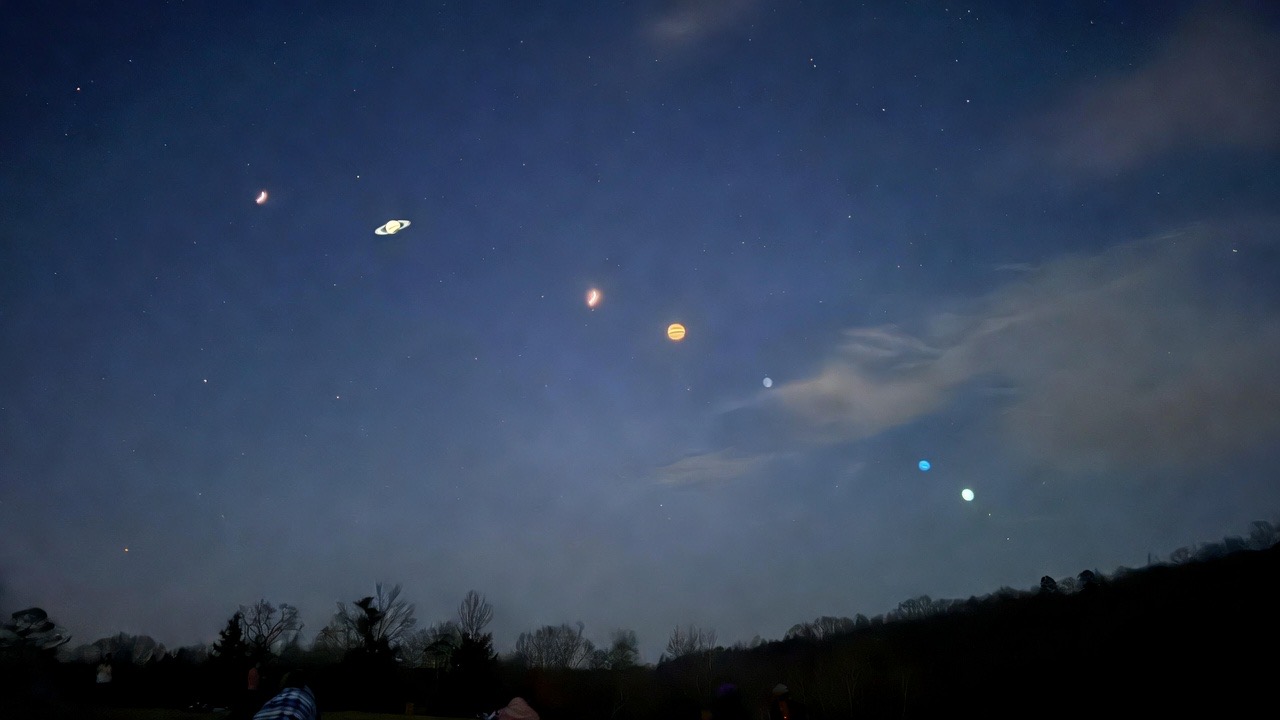


A rare celestial spectacle is unfolding across the evening sky tonight, February 28, 2026: six planets are tracing a graceful arc in what astronomers are calling a planetary parade or alignment.
Louisiana stargazers, grab a blanket, head to a spot with clear western and southern views, and look up shortly after sunset. The planets involved are Mercury, Venus, Saturn, Jupiter, Uranus, and Neptune.
Four of them—Venus, Jupiter, Saturn, and potentially Mercury—shine bright enough to spot with the naked eye under good conditions, while Uranus and Neptune typically require binoculars or a small telescope to see clearly.
This alignment doesn’t form a perfectly straight line but appears as a gentle curve across the sky because we’re viewing the solar system from Earth along the plane of the planets’ orbits (the ecliptic).
The event has been building through late February and peaks around tonight, though the planets have been visible together for several days.
Planetary Alignment: Best Time To Watch in Louisiana
The best time to observe the six-planet alignment (a “planetary parade”) on February 28, 2026, in Louisiana is shortly after sunset, specifically about 30 to 60 minutes after sunset.
This window maximizes visibility for the low western planets before they set, while brighter ones higher up remain in view.
- Key details for Louisiana (times vary slightly by exact location, e.g., New Orleans vs. Shreveport, but central/southern areas are similar):
- Sunset in places like New Orleans is around 5:58 p.m. local time (CST).
- Optimal viewing starts roughly 6:30 p.m. to 7:00 p.m. CST (or adjust for your precise sunset time).
- Look toward the western horizon initially for the lower planets (Mercury, Venus, Saturn, Neptune), then scan upward/southeast for Jupiter (higher and brighter). Uranus is between Saturn and Jupiter but fainter.
- The planets form a loose arc across the sky rather than a perfect straight line.
- Visibility notes:
- Naked-eye visible (brightest/easiest): Venus (very bright), Jupiter (high and prominent), Saturn, and possibly Mercury (lowest and trickiest—needs a clear, unobstructed western view and fades quickly in twilight).
- Uranus and Neptune require binoculars or a telescope (and darker skies away from city lights).
- Clear skies and low light pollution are essential—head to a spot with an unobstructed western horizon.
This alignment peaks around February 28 but is visible for several days around it. Sources like NASA, National Geographic, Star Walk, and local Louisiana reports (e.g., Shreveport Times, WDSU New Orleans) consistently recommend this post-sunset timing for the best shot at seeing as many as possible. Enjoy the view if the weather cooperates!